

Team
Creative Direction
Storytelling
Information Design
Data Analysis
Content & Copywriting
UX/UI Design
Front-End Development
Motion Design
Web
One
Digital brief with interactive data tables
Social
Five
Social media posts
The Challenge
In 2013, the CDC's National Center for Health Statistics published Report No. 71, a national study of how often fathers actually participate in their children's daily lives. The findings ran directly counter to a persistent public narrative, particularly about Black fathers, who reported the highest daily rates of bathing and dressing young children, the highest daily rates of homework help with school-age children, and the highest rate of self-assessment as doing "a very good job."
The report has been publicly available for more than a decade. It is also 21 pages of dense tabular statistics, standard errors, and survey methodology written for researchers. The people the data could most benefit, fathers questioning their own involvement, family counselors, journalists, and policymakers, were never going to read it.
Rise X Shine took this on as a self-initiated project to answer a specific question: what does it take to move a federal statistics report out of the archive and into a conversation?
Our Approach
The strategy was built on a single editorial principle: let the data carry the argument. Every deliverable in the ecosystem is a different pressure test of the same finding, sized for a different audience and a different attention span. The 21-page report became a scrollable brief. The brief became a chart system. The charts became stat cards built for social sharing.
The tone was set deliberately warm rather than clinical. This is data that vindicates people, and it should feel that way. The visual system, a hand-crafted felted world of dads and kids at bath time, at the science fair, in the garage, at the airport gate, was chosen precisely because it disarms. A bar chart tells you 70 percent. A felted father changing a diaper at 2 a.m. tells you what 70 percent means.
Art Driection
"Dads are kid-friendly" was the driving creative direction for the overall campaign. Using a felt surface, 3D, simple geometric shapes illustration was akin to children motion video programming — allowing dads to be approachable and relatable.


Interactive Brief
The campaign hub at risexshine.net/cdc-fatherhood restructures the report into a one-page scrollable site, designed for quick scanning and data comprension without the need for a data scientist.

The Data Visualization System
Six React and Recharts components were built and deployed as live code components in Framer, sharing one palette, one type system, and one tooltip and legend pattern so the entire brief reads as a single instrument rather than a set of borrowed charts.
The system handles a problem inherent to the source data: the survey measured four activities for children under 5 and a different four for children aged 5 to 18. Rather than fabricate a comparison, the components render an explicit note where no equivalent figure exists. Data integrity is a design decision, not a footnote.
Components include a grouped coresidence gap chart, paired race and Hispanic origin breakdowns for both age cohorts, a school-age activity comparison, and a diverging stacked bar for paternal self-rating that plots the negative end of the scale left of a zero line so the positive and negative split reads instantly.
The Social Series: Dispelling Myths
With the digital brief focusing on all the larger population of U.S. fathers, Rise X Shine used social media to highlight the involvement of African-American dads. The "absent black father" is persistent myth that permeates American beliefs. The CDC study dispels that myth, often performing better than White and Hispanic fathers in key categories.1 With just under a quarter of Americans (21%)2 consuming their news via social media, campaign leaned in on creating social media cards for easy social sharing.
Hands-on dad. 70% of Black fathers who live with their children under five bathe, dress, or diaper them every day.

Study partners. 41% of Black fathers living with school-age children help with homework every day.

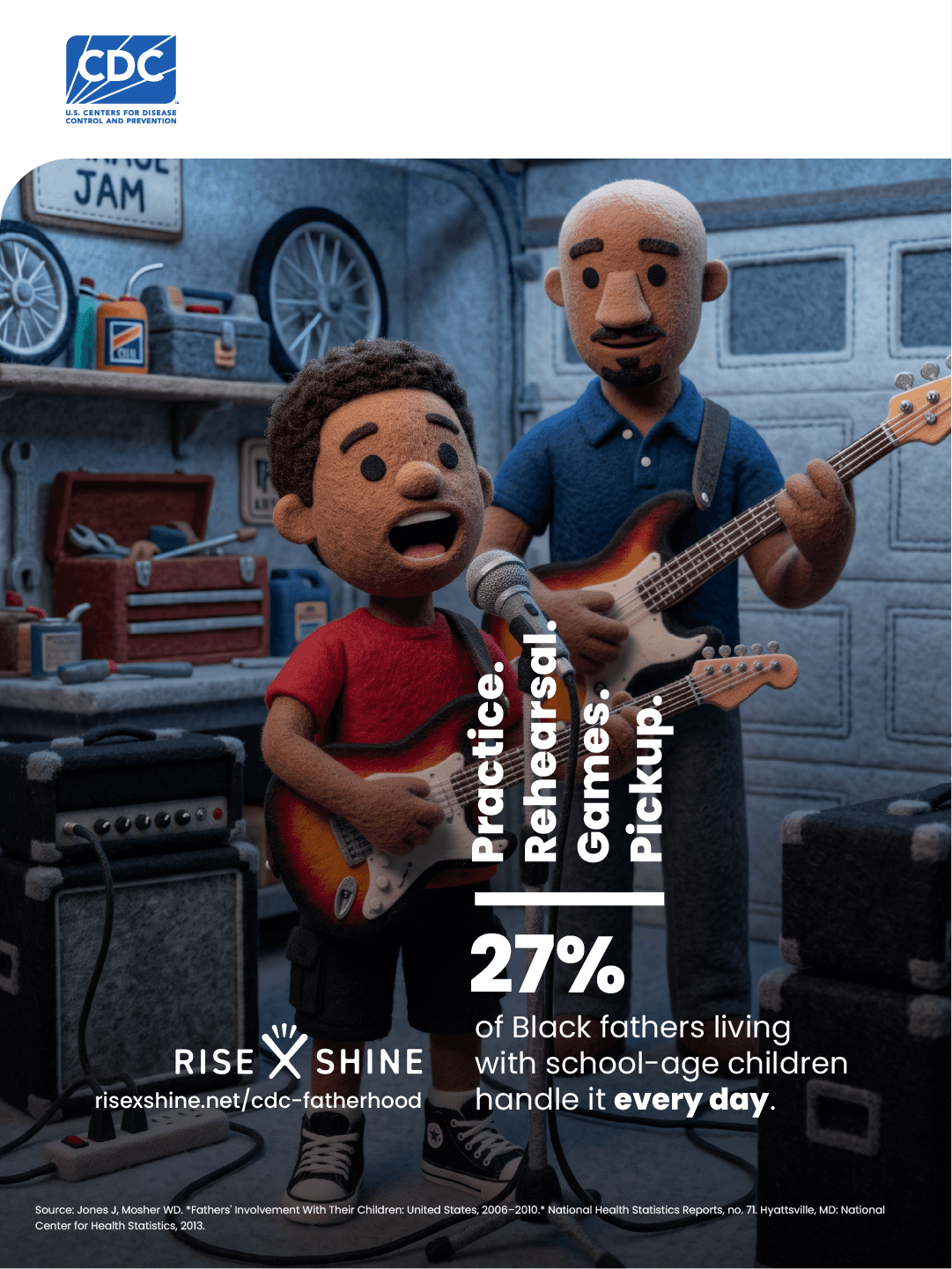
Practice. Rehearsal. Games. Pickup. 27% of Black fathers living with school-age children handle it every day.
How good a job are you doing as a father? 54% of Black fathers living with their children said: "a very good job."

Living apart. Still connected. 79% of Black fathers living apart from their children talked with them about their day in the past month.

1 "The 'Absent Black Father' Is a Myth. Data Shows Black Dads Are the Most Present" Emerald Book, Emerald Book Publication, June 21, 2026, https://emeraldbook.org/news/jun-2126/. Accessed September 10, 2026.
2 "News Platform Fact Sheet" Pew Research Center, September 25, 2025, https://www.pewresearch.org/journalism/fact-sheet/news-platform-fact-sheet/. Accessed September 10, 2026.

